
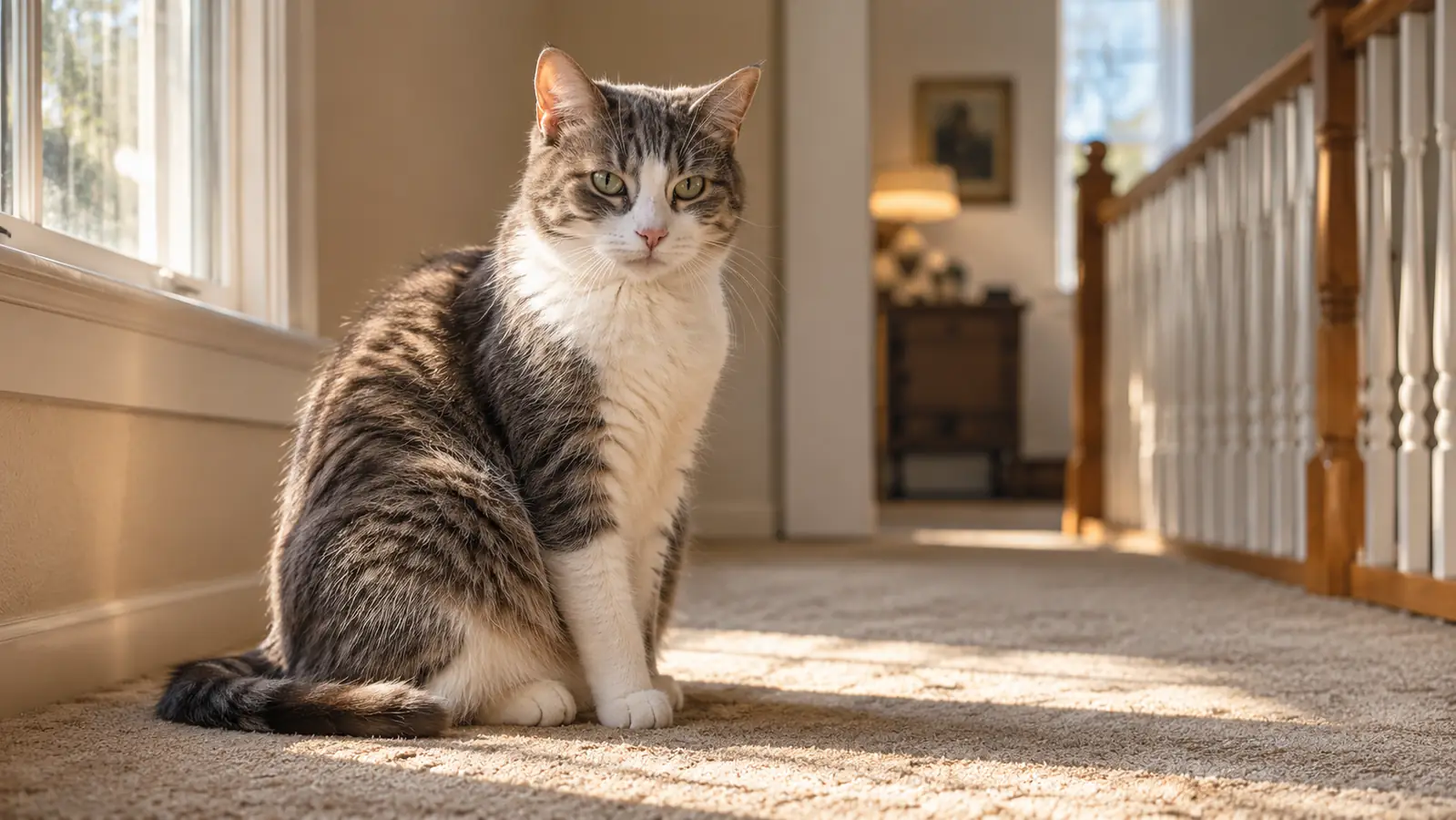
Pepper is twelve years old, gray and white, about eleven pounds, indoor only, and she has one hobby: the patch of upstairs carpet where the sun lands at four in the afternoon. At her last checkup our vet said three things to watch as she gets older. Weight, teeth, water intake. I wrote them on the back of an envelope and stuck it to the fridge. The weight I understood. The water I understood, since she is a picky drinker and always has been. The teeth I did not understand at all, because in twelve years I had never once opened my cat's mouth on purpose.
That is how a 4.6 ounce pouch of Greenies Feline Dental Treats ended up on my kitchen counter, next to the coffee can. Roasted chicken flavor. I did not buy them because I read a study. I bought them because I was standing in the feed store aisle with an envelope in my pocket and a cat at home who will not let me near her face with anything on a handle. Six months later I have opinions. Most of them are not the opinions printed on the bag, which is why I am writing this down instead of just nodding along with the label.
The Quick Verdict
The one dental product Pepper will actually take from my hand, six months running. It is a treat that scrapes, not a cleaning, and I would not want anyone buying it thinking otherwise.
Amazon Check Today's Price →The only dental habit that survived six months on my counter
Greenies Feline Dental Treats, roasted chicken flavor, in the 4.6 ounce pouch. One a day, straight from the pouch, no toothbrush required. Check today's price on Amazon.
Amazon Check Today's Price on Amazon →What Nobody Tells You Before the First Pouch
Here is the thing the front of the bag cannot say out loud. These are not a cleaning. Greenies calls them the number one veterinarian recommended treat for cat dental care, and the listing points to clinically proven oral care, and both of those statements are about the treat scraping at the outer surface of the tooth. It is mechanical. The chewing does the work. Which means the product only helps the teeth that actually get chewed on, and it does nothing for the gum line, nothing for the tight space between teeth, and nothing for anything already hardened into place.
Our vet put it in plain words for me. Treats like these help slow the buildup. They do not remove what is already there. If your cat has visible brown crust on the back molars or red gums, a treat is not going to fix it and you should be calling the clinic, not the feed store. I say that first because I spent two weeks early on assuming the bag was promising more than it was. It is not. I was.
The second thing nobody mentions is how small the pouch is. 4.6 ounces sounds like a number until it is in your hand. In our house one pouch lasts a few weeks with a single eleven pound cat on one treat a day, and if you have two cats you should plan accordingly. This is not something you buy once. It is a habit you keep buying, and the habit is the whole point. I counted once, out of curiosity, the way you count things when you are avoiding a phone call. I got forty one treats out of the first pouch before I stopped counting, which put us at just under six weeks. That was five weeks and a bit of daily use, plus a couple of pieces that went in the trash. So call it a pouch and a bit every six weeks for one cat, and do the arithmetic for your own house before you decide the price is small.
The third thing is the daily part. Nobody sells you the daily part. A bag of treats is not a routine until you make it one, and the first two weeks are the test. I put the pouch where I make my own coffee, so the cat gets hers while I get mine. That sounds like a small piece of nothing. It is the reason we are still doing this in month six.
How I've Used Them, and How I Haven't
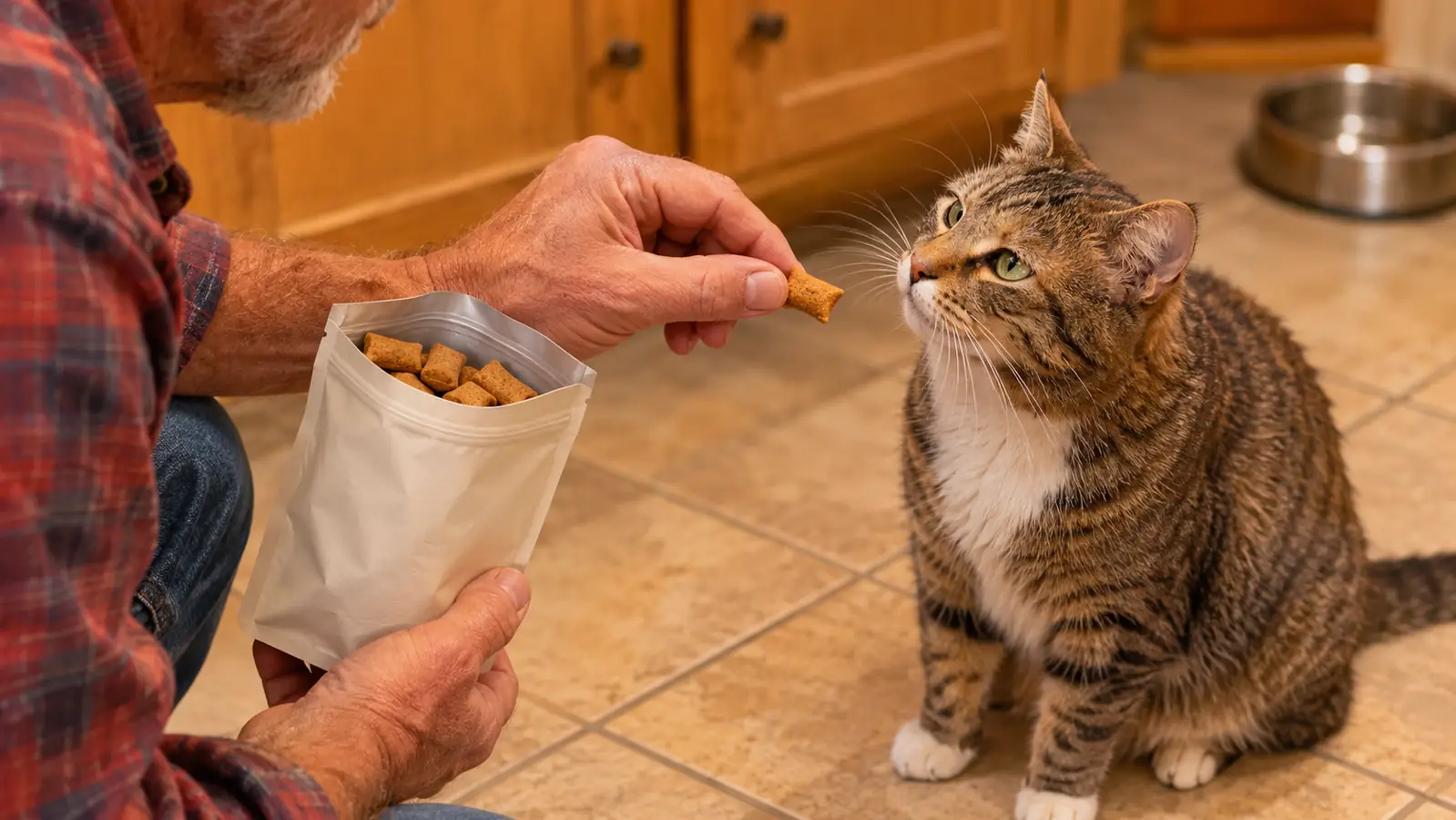
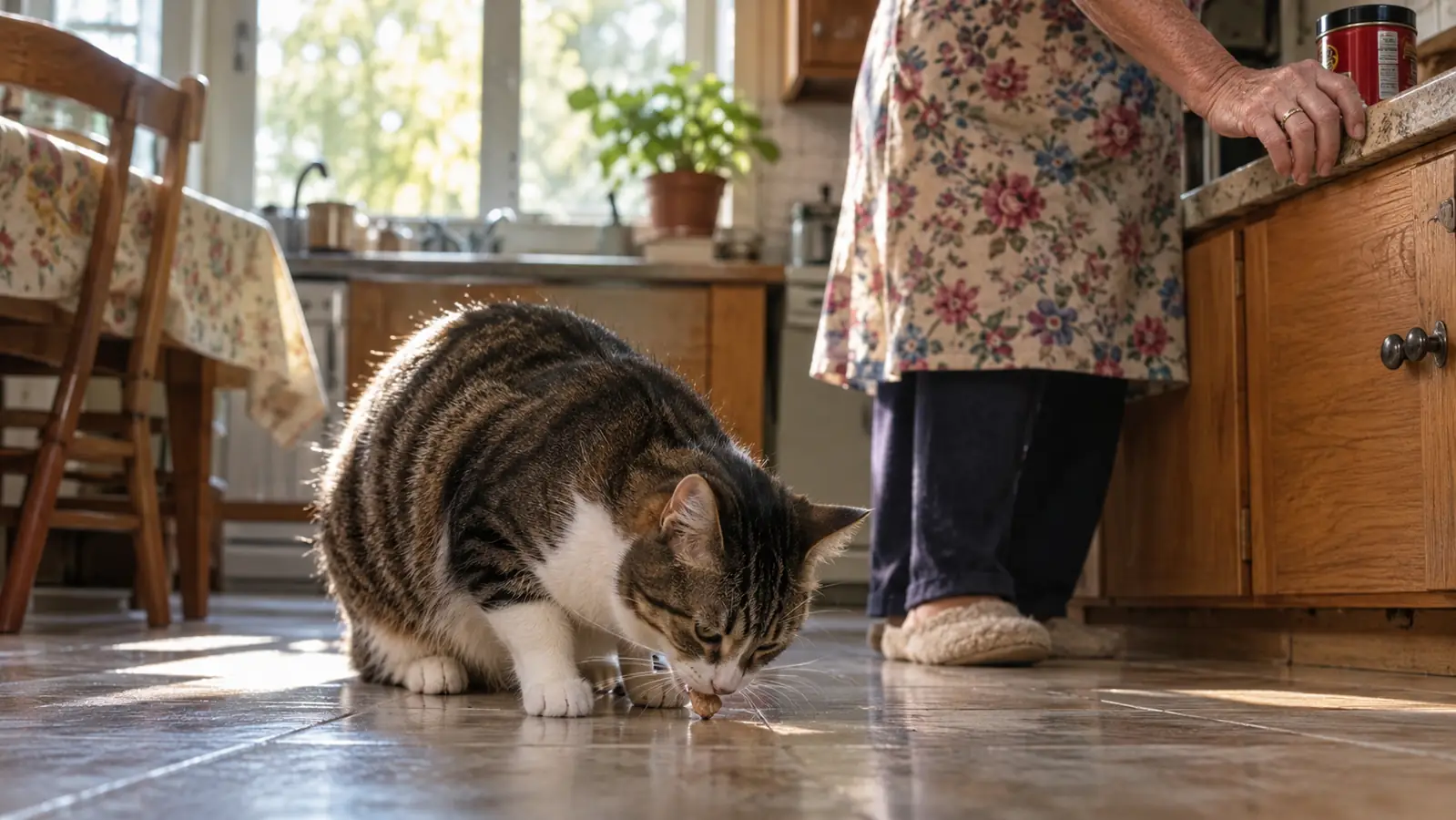
One treat a day, after supper, on the tile floor in the kitchen where her bowl lives. Not mixed into her food, because mixing hides the texture and the texture is the reason the thing works at all. Not tossed on the carpet either, since I have stepped on enough damp cat objects in my life. I hand it to her. She carries it to the same spot by the dishwasher, crunches it in about twenty seconds, and comes back to look at me like I may have made a mistake.
The first week I watched her stomach, because Pepper has always been sensitive and I have learned not to change anything in her routine without a week of suspicion. No upset. No change in the laundry room litter box. That is one cat, not a study, and every cat is different. If yours has a history of bringing up new things, give one treat and wait a day before you commit to a pouch. I started on a Monday and wrote nothing down, which I regret, because by Thursday I was trying to remember whether the litter box had looked the same on Sunday. It had. She ate her regular meals at the regular times and slept in her usual spot on the back of the couch. The one thing I noticed was that she drank a little more that week, and I have no idea whether that had anything to do with the treats or the weather turning.
What I have not done is use these as a replacement for anything. I still take her in for her checkups. I still do not brush her teeth, which is the honest confession underneath this whole article. What changed is that the dental conversation at the vet stopped being about what I ought to be doing and started being about what is actually happening in her mouth. That is worth more to me than the treat itself.
The 36% Number, Put In Context
The bag and the listing both lean on a 36% figure tied to tartar, along with the phrase clinically proven oral care. I want to be careful here, because I am not a vet and I have not read the underlying studies. What I can tell you is what that kind of number means in practice. In the company's own testing, cats getting the treat had measurably less tartar than cats that did not. It does not mean your cat's teeth will be 36% cleaner next Tuesday. It means that over months, with daily use, a small scrape adds up to something a vet can measure.
That distinction is why I kept going past week three. Weeks one through three I saw nothing, because there was nothing to see yet. The treat is doing a tiny amount of work, every day, on the flat outer surfaces of the teeth. Tiny work every day is how tartar actually gets managed. It is also the least exciting sentence I have ever written, and it is the true one.
The texture matters more than I expected. The pieces come in a wafer form, crunchy enough that Pepper has to work at them and not so soft that she can swallow them whole. A soft treat would defeat the purpose entirely. If your cat inhales food without chewing, watch the first few closely, because a cat who gulps these down is getting a chicken snack and nothing more.
These are not a cleaning. They are a scrape, once a day, and the once a day is doing most of the work.
What Six Months Actually Looked Like
At the four month mark I thought the brown line along her big back teeth looked thinner. I asked Ed, who is not a dentist and does not want to be one, and he said he could not tell the difference. So I have one opinion and one shrug. I am keeping both, because that is the honest version and the honest version is the only kind worth putting on a page.
What I can say with more confidence is what changed about her breath, which is the thing I noticed before I noticed anything about her teeth. It went from a smell I could catch when she yawned across the room to a smell I have to be close to notice. Not gone. Reduced. I am not going to dress that up as a dental exam, and I am not going to pretend I imagined it either. I first noticed it on a Saturday morning in the kitchen, when she yawned in my face while I was tying my shoes. I remember thinking, that is not the smell. Then I stood there a minute trying to decide whether I had simply gotten used to it. Both things can be true at once, which is the trouble with judging your own cat by your own nose.
The other change was on my end, not hers. The habit stuck. Twelve years of good intentions and this is the first dental thing I have kept up for half a year, because it takes four seconds and the cat is enthusiastic about it. Products that require a struggle get quietly dropped in this house. Products the animal enjoys get to stay.
One checkup falls inside that six months, and our vet said the same sentence she always says, which was to keep doing what we are doing and watch the weight. I want to be straight about that. She did not clap. She did not tell me the tartar was gone. Nothing dramatic happened in that room, and dramatic is what people write about, which is why so much of what you read about dental treats sounds like a commercial.
The Details I Did Not Expect
The treats smell strongly of roasted chicken. Not a faint chicken scent, an actual chicken smell. Pepper hears the pouch before she sees it. If you have a cat who comes running at the sound of a can opening, expect the same here, and expect to lose the ability to open the pantry quietly ever again.
The ingredient list is short, and the bag says no artificial flavors, which matters to me more than it used to. The allergen line names chicken meat, so if your cat has a chicken sensitivity, this is chicken, plainly and without apology. There is no version of this product that is not chicken. That is worth knowing before you buy a pouch and find out the hard way at two in the morning.
The pouch is listed as odor resistant, and I honestly cannot confirm that because I decant mine into an old glass jar with a lid. The jar was a jam jar, washed and dried, sitting in the cupboard doing nothing. The pouch reseals fine on its own, but a pouch left on a counter gets knocked over, and I got tired of picking treats up off the tile. In the jar they stay dry, and Pepper cannot smell them through the glass, which has cut down on how much staring she does at the counter while I am trying to cook. The bag also lists all breed sizes, and while Pepper is a fairly average eleven pounds, the pieces look manageable for a smaller cat and for a bigger one. Nothing about the size struck me as a risk.
What I Liked
- Pepper takes it from my hand without a fight, which is more than I can say for any brush
- The crunchy wafer texture gives a real scrape, not a soft snack
- One a day is easy to keep up, and the habit is the part that does the work
- Short ingredient list, no artificial flavors, and chicken listed plainly as an allergen
- Works for cats who refuse anything that looks like grooming
Where It Falls Short
- Not a cleaning and not a substitute for a vet dental
- The 4.6 ounce pouch goes quickly in a house with more than one cat
- Chicken only, so cats with a poultry sensitivity are out
- A cat who swallows food whole gets no scraping benefit
- You have to keep buying it, which is the idea and also the catch
Where They Fall Short
The biggest one is the one I keep repeating, so I will say it once more and then stop. These do nothing for gum disease, nothing for a tooth that already has a problem, and nothing for the parts of the mouth you cannot see. If your cat is drooling, pawing at her face, eating on one side, or has breath that could strip paint, that is a vet visit and no treat on earth stands in for it. I say that as someone who has delayed a vet visit out of a wish that a product would handle it for me.
The second shortcoming is supply. One pouch is not a commitment device. I have forgotten to reorder and lost three days, then four, and a habit with holes in it is not a habit. I now buy two at a time, which Ed has opinions about and which has kept us consistent.
The third is weight. Our vet told us to watch Pepper's weight, and a treat is food. It counts, whether it scrapes or not. I pulled back slightly at her regular meals to make room. That is not dramatic, but it is not nothing either. If your cat is on a measured diet, count these in it rather than on top of it.
Who This Is For
This is for the owner whose vet has already said the word teeth and who has no intention of wrestling a cat with a toothbrush every night. It is for the person with a cat who will not tolerate anything near her face but will happily take a snack. It is for someone who wants a small, boring, daily thing that adds up, and who understands that small boring daily things are the only kind that ever add up.
It is also for the owner who wants to start early, before there is a problem. That is the group I would push hardest. Once tartar is established, a treat is maintenance at best. Before it is established, a treat is a habit that may keep the vet's sentence short at the next checkup. That is a modest promise. It is the one I would actually make.
Who Should Skip It
Skip it if your cat has a diagnosed dental problem right now. Skip it if your cat has a chicken sensitivity, or if your vet has put her on a restricted diet, because this is chicken and it is food. Skip it if you want something that replaces a professional cleaning, because nothing does, and you will be disappointed by month two and blame the pouch.
And skip it if you know yourself well enough to know you will not keep up with a daily anything. I mean that kindly. I have a closet shelf full of things I was going to keep up with. The only reason this one survived is that Pepper asks for it, and a cat asking for something is a stronger engine than my self discipline has ever been.
If the vet already said teeth, start with the boring daily thing
Greenies Feline Dental Treats in roasted chicken flavor. One a day, straight from the pouch. It will not replace a cleaning. It is the part you can actually do on a Tuesday night.
Amazon Check Today's Price on Amazon →