
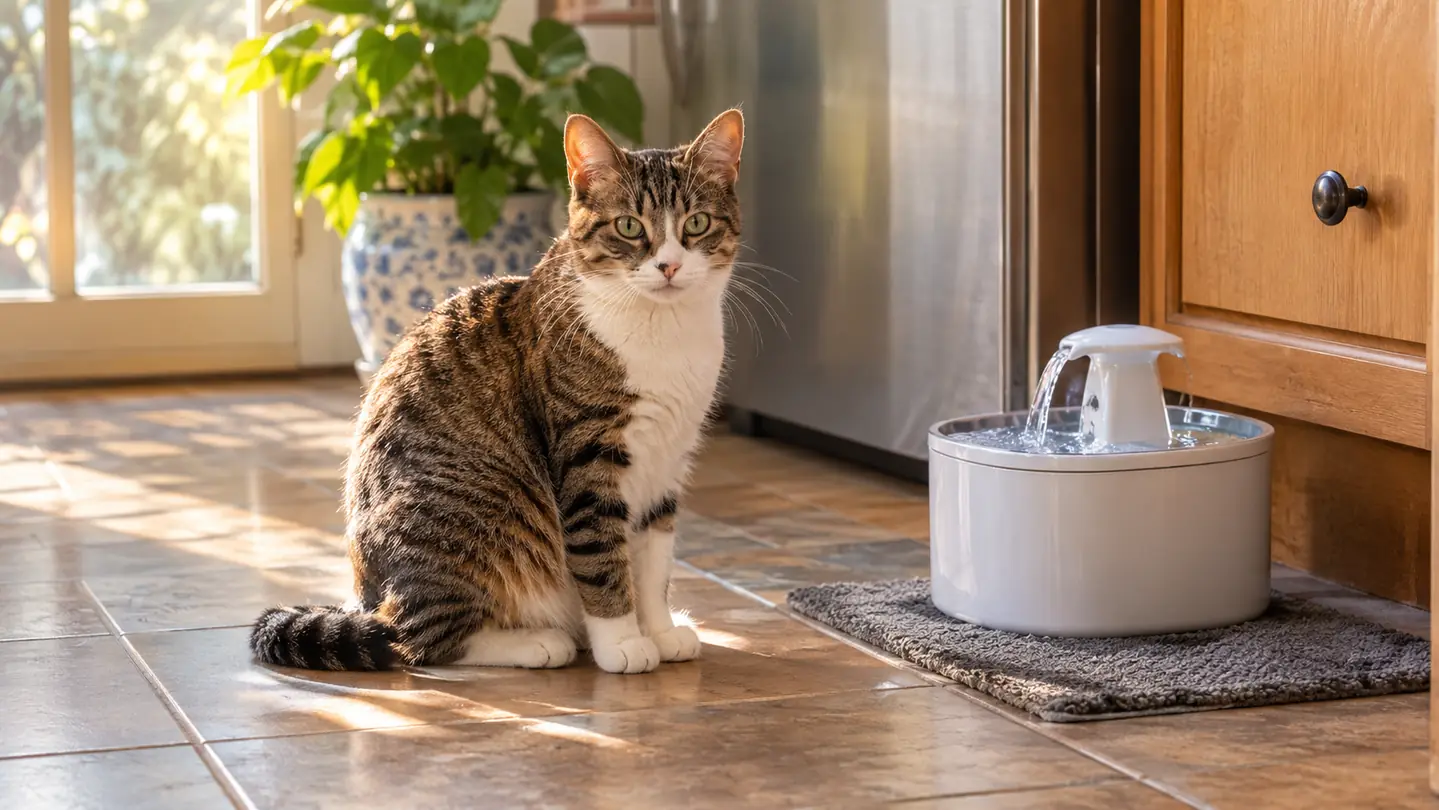
Pepper is twelve, eleven pounds, indoor only, and picky about nearly everything. Water is high on that list. She will drink from a ceramic bowl, but only after a long suspicious look at it, and only two or three times a day. At her last checkup our vet said to keep an eye on how much she drinks, along with her weight and her teeth. That is how a retired school librarian ends up reading about water pumps at ten o'clock on a Tuesday night.
Here is what I did not understand at first. A cat who laps at a bowl twice on Tuesday and twice on Wednesday looks perfectly normal. Cats are built to get by on very little water, which is exactly why a slow drop in intake is so easy to miss. So I made one change and left the rest of Pepper's day alone. I put a Veken cat water fountain on the kitchen tile, filled it, and then spent two weeks watching a twelve-year-old cat decide whether she approved. These are the five steps that actually moved the needle, in the order I did them.
One fountain, two flow settings, and a cat who finally drinks
The Veken C1 Classic holds 95 oz (2.8 L), runs on a 6 ft cord, and gives you either a flower waterfall or a gentle fountain. It is the unit humming on my kitchen tile right now.
Amazon Check Today's Price on Amazon →Five Steps That Worked for Pepper
Step 1: Set it up before your cat ever sees it
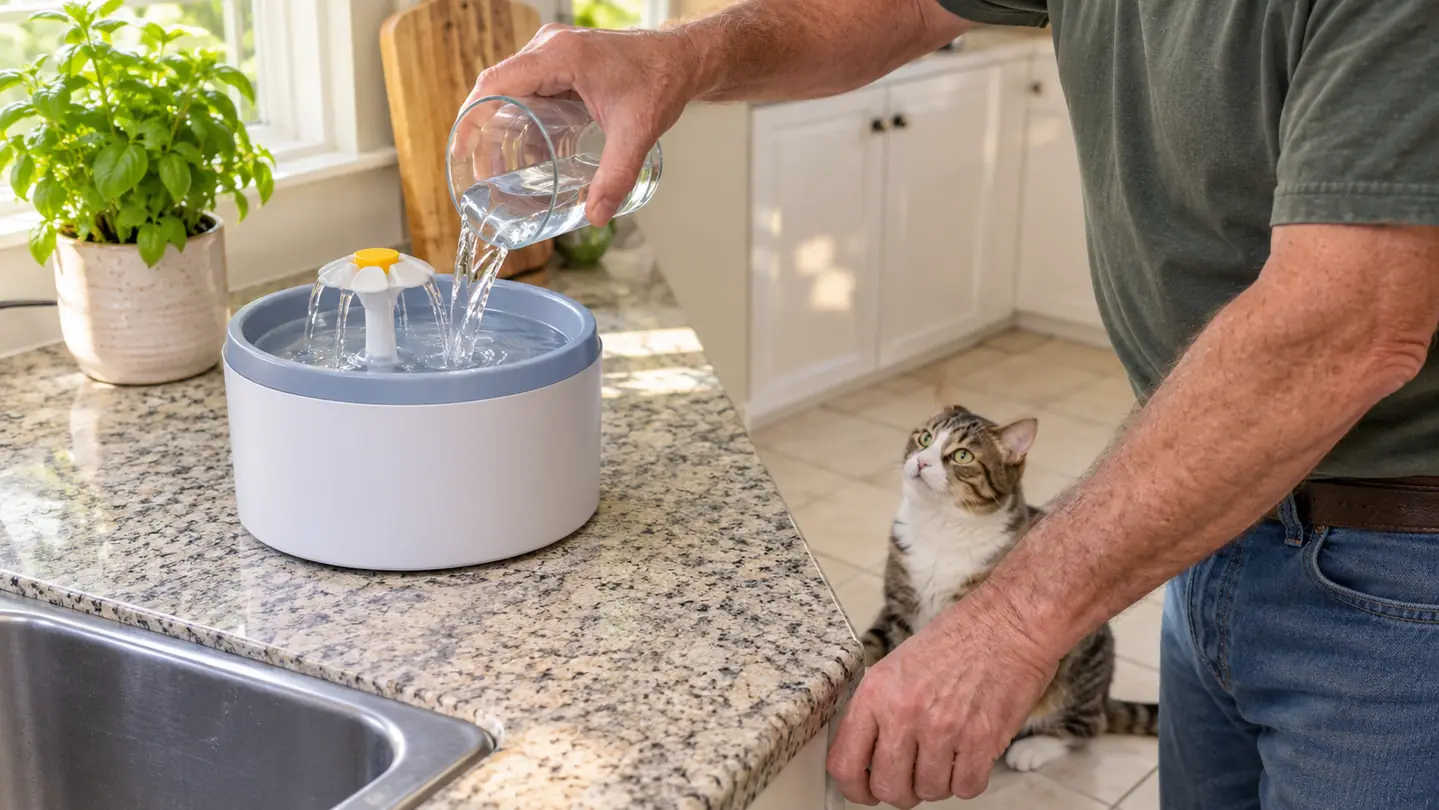
The first thing I did was unbox the Veken in the laundry room with the door shut. Fountains arrive with a new-filter taste and a pump that needs a little time to settle, and a cat's first impression is almost impossible to undo. I rinsed the filter cartridge under cool running water, filled the basin to the water-level window, plugged in the 6 ft cord, and flipped the switch on the cord. Then I let it run for twenty minutes in the other room while I made dinner and pretended I was not nervous.
By the time I carried it into the kitchen, the water had come up to room temperature and the pump hum had dropped to something closer to a refrigerator than a fish tank. That mattered more than I expected. Pepper walked over, sniffed the edge of the basin, and left. But she came back. She came back four times that first evening without drinking once, which I now understand was her doing the inspection.
One practical note before you start. The 5-stage filtration is the reason I bother with a fountain at all, because moving water on its own does not stay clean. The manufacturer's instructions say to clean the pump and replace the filter every one to two weeks. Put a repeating reminder in your phone on day one, because you will not remember on your own, and neither did I.
Step 2: Put it where she already drinks, not where you want it
The instinct is to tuck a fountain somewhere out of the way, and I did the opposite. Pepper's water had always lived on the kitchen tile, so the fountain went exactly there. Same corner, same tile, same view of the back door. The unit is just over eight inches across, so it sat in the same footprint the bowl had occupied. Only the bowl changed. That was the entire point.
I kept it about three feet from her food dish instead of right beside it. Some cats prefer their water away from their dinner, and three feet costs nothing to try. I also pushed it against the wall so the cord runs straight down and back rather than across the floor where I would trip over it twice a day carrying groceries.
Here is the small thing that turned out to matter most. The blue LED light and the water-level window are both visible from standing height, so I can see at a glance whether the basin is low without lifting anything. In a house where the cat is the only one paying close attention to her own hydration, that window is the feature I use every single day.
Step 3: Pick one flow setting and leave it alone for a week
The fountain has two modes. The flower waterfall sends water over the top like a running faucet, and the gentle fountain keeps things moving with less splash. I chose based on what Pepper already did, which was sit on the bathroom counter and stare at the tap until somebody turned it on for her. Faucet drinker. So, flower waterfall.
Then I did the hardest thing on this whole list. I left it alone for seven days. No switching modes to see which she preferred, no nudging it two inches to the left, no standing in the doorway watching her. Cats read that kind of attention as pressure. Every time I fussed with the fountain, she found somewhere else to be, and the kitchen is not that big.
If your cat is nervous about noise or splash, start with the gentle fountain instead and give it the same week. The point is not which mode is better on paper. The point is that nothing in her environment changes while she works up the nerve to try it.
Step 4: Keep a still bowl, and move it a little each week
I did not take the ceramic bowl away, and I would not recommend it. A cat who is already on the edge of not drinking enough is the last cat you want to force into a standoff over. The bowl stayed, full and clean, in its usual spot. If your cat has a condition your vet is already tracking, or you have been told to watch her water intake closely, talk to them before you move anything at all. I am not a vet. I am a woman with a cat and a notebook.
What I did instead was move the bowl about a foot farther from the kitchen every Sunday. By week three it was on the mat by the back door, which is farther than Pepper likes to walk for a drink. That was the week she started using the fountain without checking the bowl first. Honestly, I think she just got tired of the commute.
This is the step most people skip, and it is the one that decides whether the fountain becomes furniture or becomes her water. You are not removing the option. You are making the easy option slightly less easy, a foot at a time, while she is not looking.
Step 5: Clean the pump and change the filter on a schedule
This is the step that separates a fountain that works from a fountain that starts to smell like a pond. Every one to two weeks, unplug it, take the pump apart, and rinse it under the tap. The impeller is small and it collects hair. A pump with hair wrapped around it gets loud first, then gets weak, and a weak fountain is just a bowl with extra steps.
Filters are inexpensive and I buy them in a pack so I never have an excuse to skip a week. When the water starts to smell faintly of nothing in particular, or the flow looks thinner than it did a few days ago, that is my cue. I also wipe the basin with a soft cloth and never anything abrasive, because the body is plastic and scratches hold onto film no matter how well you rinse.
The Veken carries a two-year warranty, which I noted when I bought it and then promptly forgot, the way you do. What I did not forget is that a clean fountain is the only kind a picky cat will keep using. The newness is what gets her to try it. The maintenance is what keeps her there.
What Else Helps
The fountain was the big change, but it was not the only one. I added a second water source upstairs, a plain wide bowl on the landing, because a twelve-year-old cat in a two-story house does not always want to do the stairs for a drink. Wide matters more than pretty. Whiskers brushing the sides of a narrow bowl bother some cats far more than we give them credit for.
Wet food helped too. I asked our vet how much water I could reasonably add to Pepper's meals and I did what she said rather than what I read on a forum. That is a conversation worth having, because the answer depends on the cat, her kidneys, and whatever her last labs showed. It is not a number you should take from me.
The last thing that helped was leaving everything else alone. I did not move the litter box in the laundry room, I did not change her food, and I did not rearrange the kitchen. A picky cat under a little stress will quit drinking before she quits almost anything else. Change one thing, wait a week, then change the next thing. Boring, but it works.
Pepper went from two quick visits to the bowl each day to four or five trips to the fountain. I only know that because I started writing it down, one hash mark at a time, on the back of the grocery list.
What to Do If She Still Will Not Drink
Some cats never take to a fountain. I want to be honest about that, because I have read plenty of articles promising that every cat converts in three days, and that is not how cats work. If two or three weeks pass and the fountain is ignored, the fountain is not a failure and neither are you. Keep the still bowl, try a different corner, and try again in a month.
What you should not do is wait to see whether she gets thirstier. If your cat stops drinking, starts drinking far more than usual, hides, or her gums feel tacky instead of wet, that is a call to your vet and not a shopping decision. The same goes for a sudden change in how much she urinates. Water intake is one of those quiet signals that is always worth a phone call.
For us, the fountain worked. Pepper drinks more, she is easier to keep an eye on, and the kitchen tile has one more appliance humming on it than it did last spring. If your cat is picky, start with step one and set the thing up before she ever sees it. Then give her the week. That part is not optional.
Set it up on Saturday. Give her the week.
The Veken C1 Classic holds 95 oz, runs on a 6 ft cord, and comes with two flow modes and a two-year warranty. Every step in this article starts with getting one onto the tile.
Amazon Check Today's Price on Amazon →