
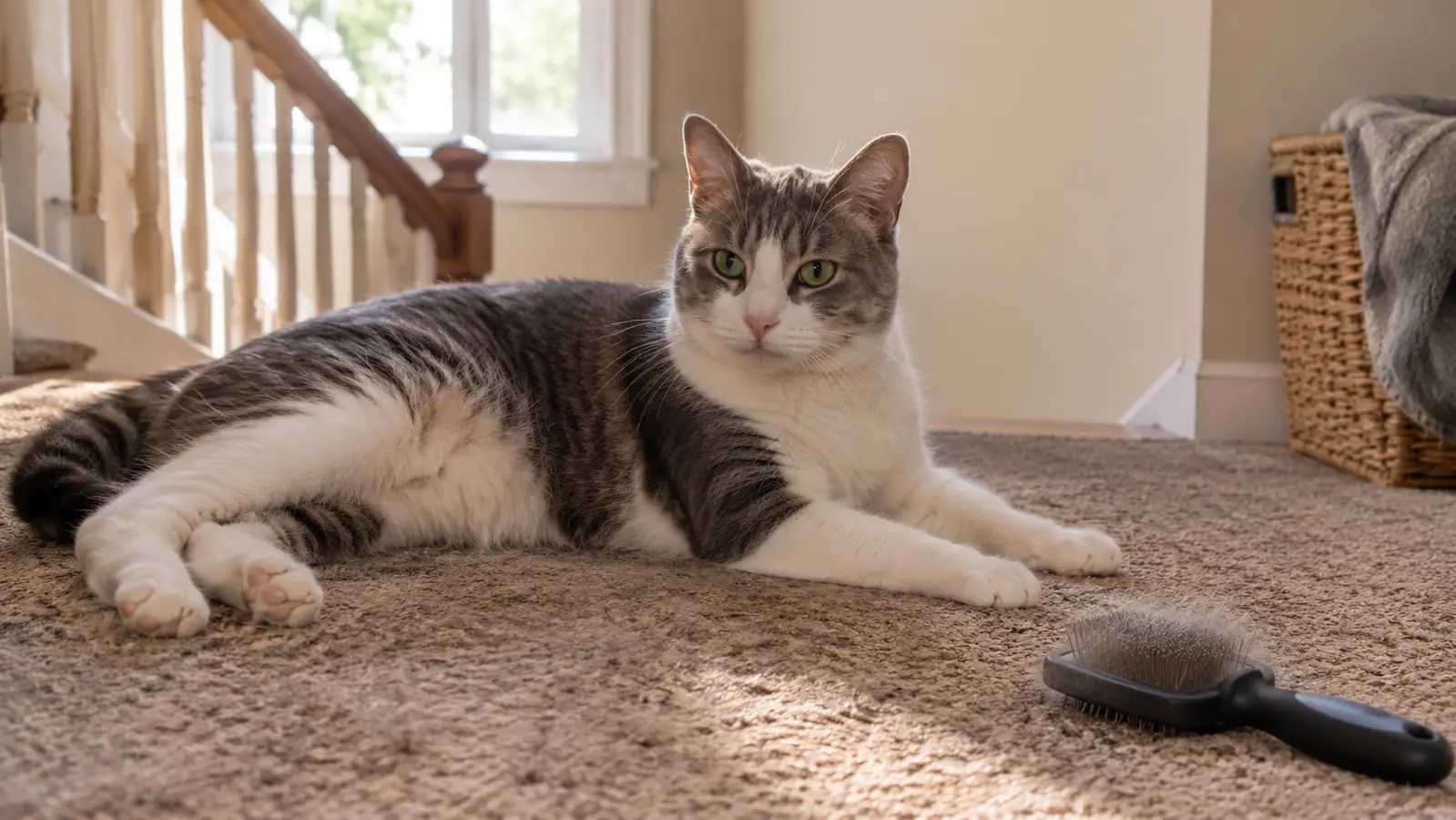
The first pass with the FURminator pulled a tuft of gray fur off Pepper about the size of a mouse. She is a short-haired cat. Twelve years old, eleven pounds, indoor her whole life, and for the past decade I had assumed that short hair meant low shedding and that our vacuum was simply losing. It was not the vacuum. That first handful of fur was the start of a lesson in how much coat a cat carries that you never actually see.
Pepper is picky about everything. Her water, her food, the exact square of carpet she sleeps on. I expected her to hate this. What I did not expect was that after a few weeks she would walk toward me when I picked the tool up, which is either affection or a very polite demand. What follows is a full season of steady use, two sessions a week, plus the parts of the FURminator that still irritate me.
The Quick Verdict
Pulls a startling amount of loose undercoat off a short-haired cat in five minutes, and the curved stainless edge is gentle enough that Pepper stopped leaving. It does not stop shedding, and it is very easy to overdo.
Amazon Check Today's Price →The fur that was living in the sofa cushions is now in a paper bag
This is the medium-to-large cat tool for short hair, the one sized for cats over ten pounds. It is what I reach for twice a week. Check today's price on Amazon before your next vacuum.
Amazon Check Today's Price on Amazon →How I've Used It
Pepper has been indoors since she was a kitten. Her coat is short and dense, the kind that looks sleek from across the room and then leaves a gray film on every upholstered surface in the house. Before this I used a soft bristle brush and a rubber mitt. Both made her purr. Neither removed anything you could hold in your hand. I would finish a grooming session feeling like a good caretaker and then sit down on the sofa and get up wearing her.
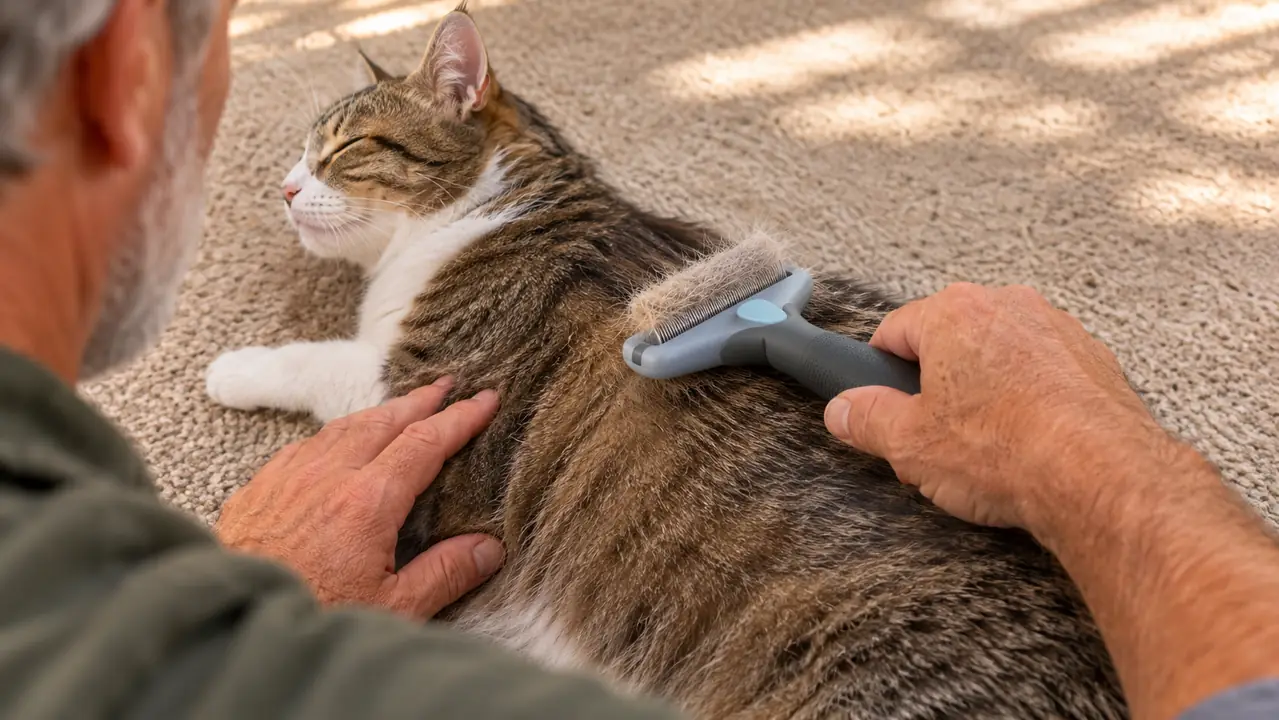
Now the routine is twice a week, five minutes at a time, on the carpeted upstairs landing where she already likes to lie. I start at her shoulders, work back along her spine in short strokes, then do the flanks, and finish with the tail. The tool weighs a little over five ounces, which matters less for my wrist than for her: she can tell when I am holding something heavy and she reads that as a bad sign. This one she ignores.
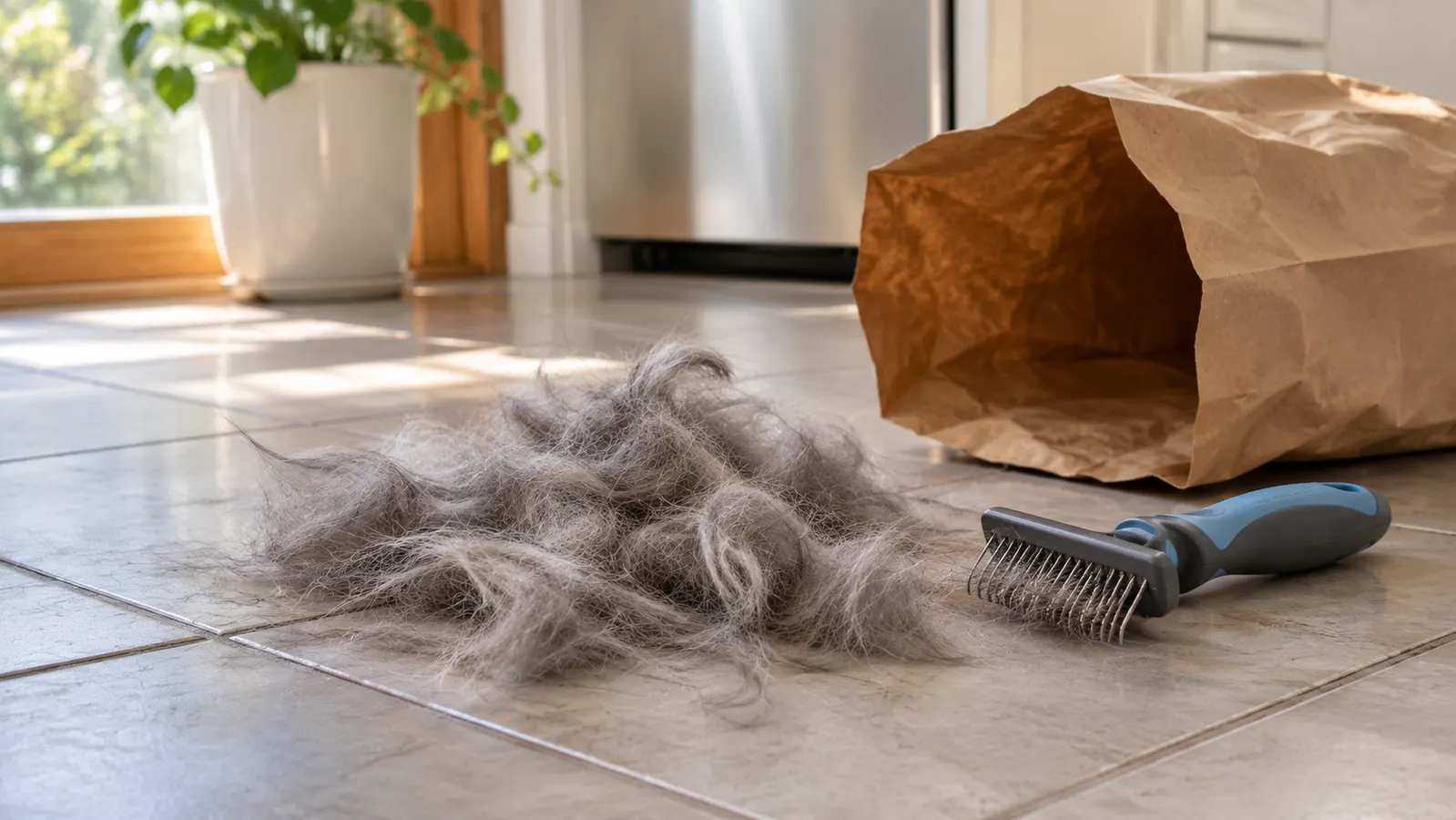
One session in the first week produced enough loose hair to stuff a small pillow. I am not dressing that up for effect. I put it in a sandwich bag to show Ed and he asked whether the cat was ill. She was not. It was simply coat that had been sitting in her undercoat for years, waiting for something sharper than a bristle brush.
What the Tool Is Actually Doing
The working part is a stainless steel deShedding edge, not bristles. It reaches through the topcoat to the loose undercoat and lifts that hair out instead of pushing it around the surface. That is the whole difference between this and the brush you already own. The bristle brush rearranges the top layer and makes the cat look tidy for an hour. This reaches the layer underneath, which is where the fur that ends up on your baseboards actually lives.
The edge is curved, and that curve is the detail that made this workable for Pepper. A straight blade catches at the ends of each stroke and digs. This one tends to glide along the shape of her back and shoulders, so it follows her build instead of fighting it. There is a guard over the edge as well, which is why it stops short of scraping skin. I still keep my free hand on her to feel how much pressure is actually going in, because the tool will not tell me.
The handle is a rubberized grip and the body is oblong, about 8.75 inches end to end, so I have enough length to hold it one-handed while the other hand keeps Pepper from sliding off the landing. The listing says to choose the large size for cats over ten pounds. Pepper is eleven, so that is the one I bought. Measure rather than guess, because the width of the edge decides how much coat you cover in a single stroke, and too narrow means twice the passes.
The First Month Around the House
The first change was not on the cat. It was on the rug in the upstairs hallway. For years I had been finding gray drifts along the baseboards and assuming it was seasonal, something she did in spring and then stopped. Two weeks into regular use the drifts thinned out to almost nothing. Same cat, same house, same vacuum. The difference was that the loose coat was coming off into a bag instead of settling into the carpet pile.
The second change was hairballs. Pepper has a sensitive stomach and had been bringing them up roughly every ten days, usually at four in the morning, usually on something I cared about. I want to be careful here. I am not a vet and I am not telling you this tool treats anything. I am telling you that in our house the frequency dropped, and when I mentioned it at her checkup our vet said the logic made sense, because coat that comes off in a bag is coat that is not swallowed. She also said to keep watching Pepper's water intake regardless, which I do, and which is a separate matter from grooming entirely.
The third change was Pepper. She has never liked being handled for long. With the soft brush she tolerated it and then left. With this she comes over, sits down, and waits, which I did not expect and still do not entirely trust. Cats are not subtle about discomfort. She is not uncomfortable.
What Took Me a While to Learn
The tool does not need force. The first month I pressed, because pressing felt productive, the way scrubbing a stubborn pan feels productive. That is how you get a cat who leaves the room when she hears the drawer open. Light strokes, short ones, one pass per area. The stainless edge does the work on its own. My job is mostly to hold it at the right angle and to stop before she has had enough.
Second: do not go over the same patch until it is bare. Once the loose undercoat is out, the edge is running across skin and doing nothing useful, and it starts to feel like scratching to her. I do one pass per area, then move on. If the head comes up empty on the second pass, that patch is done and I should not be there.
Third: the head fills quickly and has to be cleared. That is not a design flaw so much as it is the cost of the thing working. I keep a paper bag next to me now and pull the fur out of the edge every few strokes. The first time I let it pack solid, I spent ten minutes picking matted fur out with my fingers and a chopstick, which is not how I wanted to spend a Tuesday evening.
Fourth: keep the sessions short. Five minutes is plenty for an eleven-pound short-haired cat. Twenty minutes gets no more hair out and costs you a cooperative cat for a week. I also skip her belly entirely. The skin there is thin, she has opinions, and there is not enough fur on it to be worth the argument. The back, the flanks and the tail are where the coat actually is.
What It Does Not Do
It does not stop shedding. Nothing does, short of a shaved cat, and that is not happening in this house. I still find fur. I find considerably less of it, and what I find is looser and shorter rather than woven into the sofa fabric, which makes it a vacuum problem instead of a upholstery problem.
It is not a mat remover. If your cat has developed mats, especially the hard felted kind along the back or behind the legs, this is the wrong tool and pulling at them will hurt. That is a groomer or a vet conversation, not a Saturday afternoon experiment.
It does not replace a vet, and I would be doing you a disservice to let that idea sit. Pepper's last checkup came with instructions to watch her weight, her teeth and how much water she drinks. A grooming tool has nothing to do with any of those three. It helps with fur on the rug and fur in her stomach. That is the whole claim, and it is enough.
How It Has Held Up
Five months in, the edge still lifts coat the way it did in week one. The handle has a couple of scuffs from being dropped on the kitchen tile. Nothing has loosened, nothing rattles, no plastic has cracked. It is a little over five ounces of metal, plastic and rubber with no batteries and nothing to recharge, and I expect it to outlast Pepper's patience for it, which is a low bar but still.
Cleaning is a rinse and a dry. I wipe the edge with a cloth, pick the fur out of the head, and set it on the counter. I do not put it in the dishwasher, though I have no idea whether that would hurt it. I have not needed to replace the edge and I have not needed to buy anything else to go with it.
What I Liked
- Lifts loose undercoat out of a short-haired coat in a single five-minute pass
- The curved stainless edge glides instead of digging, so a twitchy cat tolerates it
- Light enough to hold one-handed at about 5.44 ounces
- No batteries, no charging, nothing to replace
- Pepper comes to me when I pick it up instead of leaving the room
Where It Falls Short
- Manages shedding, it does not stop it
- The head fills fast and has to be cleared mid-session
- Very easy to overuse, particularly on the belly and flanks
- Wrong tool entirely for mats
- Size matters, and the wrong one doubles your passes
Two weeks in, the gray drifts along the upstairs baseboards thinned out to almost nothing. Same cat, same house, same vacuum.
Who This Is For
This is for the owner of a short-haired indoor cat who has already tried a bristle brush and a rubber mitt and figured out that neither one actually takes fur off the animal. If you are vacuuming twice a week and still finding gray film on the arm of the sofa, that is the signal. It is also for the owner of an older cat, because older cats groom themselves less thoroughly and swallow more of what they should be shedding. Pepper is twelve and she has slowed down on the self-grooming front. That is exactly the gap this fills.
It suits a cat who will tolerate five minutes of handling twice a week, and an owner who is willing to keep the sessions short and light. If you can commit to that, the difference shows up in the first two weeks and it is not subtle. If you are looking for something that fixes a matted coat or stops shedding altogether, keep looking, because this is neither.
Who Should Skip It
Skip it if your cat is genuinely fearful of being touched, or if grooming has already become a two-person wrestling match. A sharper tool in that situation makes things worse, not better, and the right first step is a conversation with your vet about how to build tolerance, not a purchase. Skip it too if your cat is long-haired. The short-hair edge is built for a specific coat type and the listing is clear about that, so buying the short-hair version for a long-haired cat is a waste of your money and your cat's patience.
And skip it if a matted coat is the actual problem. That needs a person with clippers, not a tool from a box. Everything else, the fur on the rug and the fur in the cushions and the coat that never seems to come off with a brush, this handles, and it handled it for us in the first two weeks.
Five minutes, twice a week, and the rug in the hallway stays clean
The FURminator medium-to-large cat deShedding tool for short hair, sized for cats over ten pounds. If you have a short-haired indoor cat and a vacuum that is losing, this is the fix I found.
Amazon Check Today's Price on Amazon →