
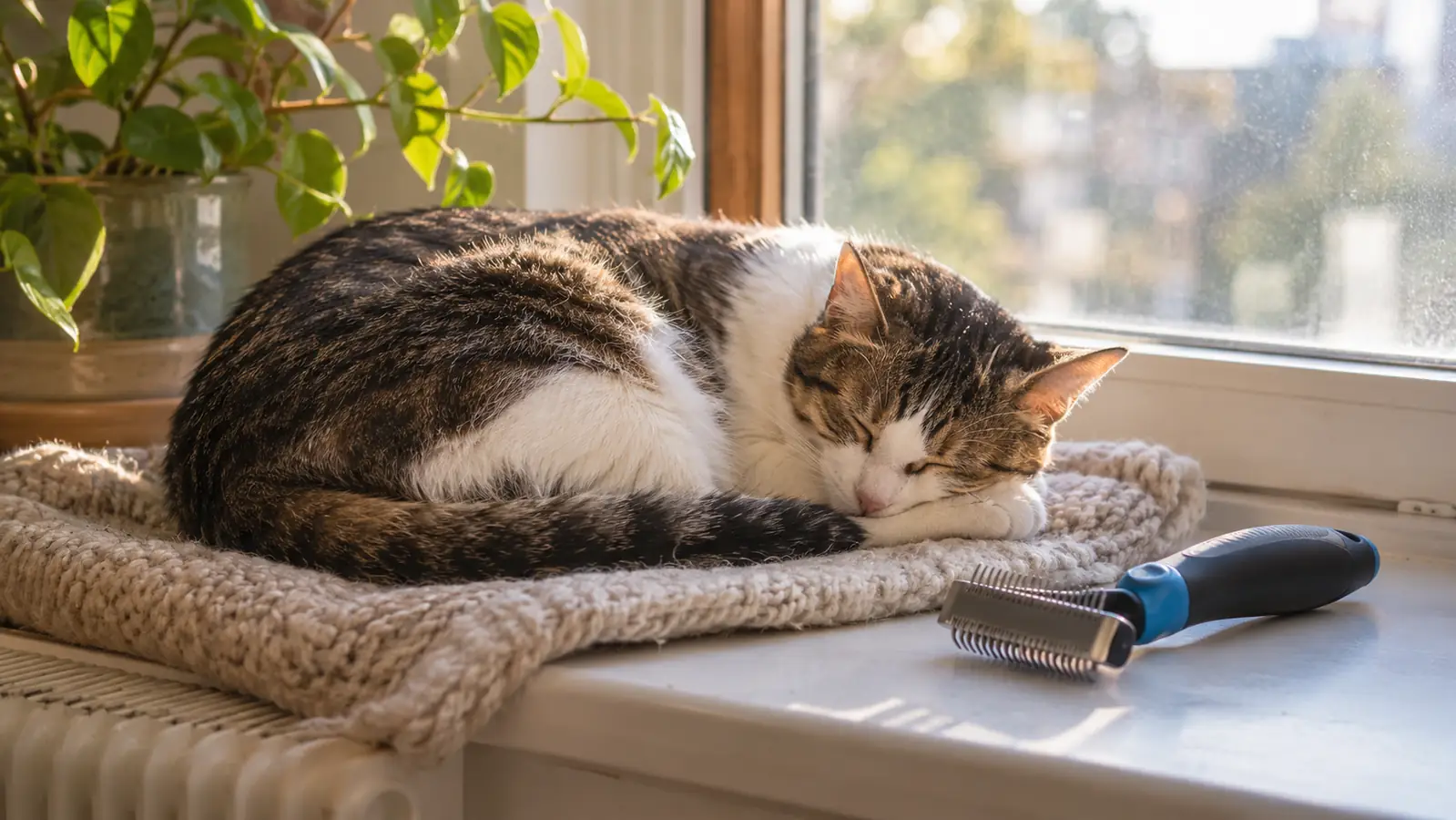
Pepper left a hairball on the living room rug on a Tuesday morning. I wiped it up with a paper towel, rinsed the spot, and did not think much about it. Then there was another one on Thursday, and a third one at the top of the stairs, which is the worst place in this house because the vacuum lives downstairs. She is twelve years old, gray and white, eleven pounds, indoor only, and until that week I would have told you hairballs were simply part of the deal with cats. They are not, or at least they do not have to be this frequent. I bought the FURminator Medium to Large Cat deShedding Tool for Short Hair, and it is the only thing I have bought for this problem that I still use every week.
Before that I tried the obvious things. A slicker brush that seemed to rearrange the top of her coat without actually taking anything off it. A rubber grooming glove she tolerated for about ninety seconds. A bristle brush from the grocery store that collected more of my own hair than hers. None of them got at the loose undercoat, which as far as I can tell is the whole job. One thing before we go on. I am not a vet. I am a sixty-three-year-old retired school librarian with one cat and a fair amount of patience. If your cat brings up hairballs often, or is losing weight, or has stopped eating, call your vet first and sort out the medical side. What follows is what worked in this house.
The first brush that actually pulled the loose undercoat out
Pepper is eleven pounds with a short coat, which puts her right in this tool's range. Five minutes, twice a week, and the fur goes in the trash instead of down her throat.
Amazon Check Today's Price on Amazon →Why Brushing Beats Every Tube of Hairball Remedy
A hairball is not a ball of hair sitting in the stomach waiting to be dissolved. It is hair, plus whatever the stomach throws at it, and it comes back up the same way it went down. Cats spend an enormous part of the day grooming themselves. Every one of those licks pulls loose hair off the coat and sends it down the throat. Most of it moves through and out the other end and you never know it happened. When more goes in than can move through, it collects. Then your carpet pays for it.
The first thing I bought was a tube of malt flavored paste from the pet store on the far side of Lancaster. The woman at the counter told me cats love the taste. Pepper licked it twice, looked at me like I had insulted her, and would not go near the tube again. I ended up smearing a ribbon of it on her front paw, which is a trick that works exactly once and only because she had to clean it off. It did nothing for the hairballs. I still have most of that tube in the cupboard under the kitchen sink, and I keep it there as a reminder.
I understand the logic of a hairball remedy. It coats things and helps them slide along. But it does nothing whatsoever about the hair going in. Take the loose hair off the cat before she swallows it and there is less to come back up. That sounds too simple to matter. It mattered here. In the first three weeks I took more fur off Pepper than I would have believed she had on her, and the hairballs thinned out.
The reason most brushes fail is that they never reach the undercoat. A soft bristle brush smooths the top layer and leaves the dense stuff underneath, which is exactly the stuff that ends up in a hairball. A deShedding tool is built differently. The edge is stainless steel, it sits close to the skin, and it lifts out the loose hair that was already working its way free.
Step 1: Match the Tool to the Cat, Not to the Shelf Label
The guidance on this tool is to choose the large size for cats over ten pounds. Pepper weighed eleven at her last checkup, which our vet said was a touch heavy for her frame, so she lands in that range. There is a short hair version and a long hair version and they are not interchangeable. Pepper's coat is short and thick, so the short hair version is the one that came home with me.
The FURminator tool itself is light, 5.44 ounces, and about 2 by 5 by 8.75 inches. It is oblong, roughly the shape of a wide comb, and it sits in my hand without much grip. The edge is curved so it follows the round of a cat's back instead of digging in at the corners. That curve is the part I noticed most, because a flat blade catches on a shoulder blade and a cat does not forget that.
One caution. Do not start on a cat with a scab, a hot spot, or a raw patch anywhere on her back. Wait until the skin is clear, or ask your vet whether brushing that area is fine. This is a grooming tool, not a treatment.
Step 2: Wait for the Sleepy Hour
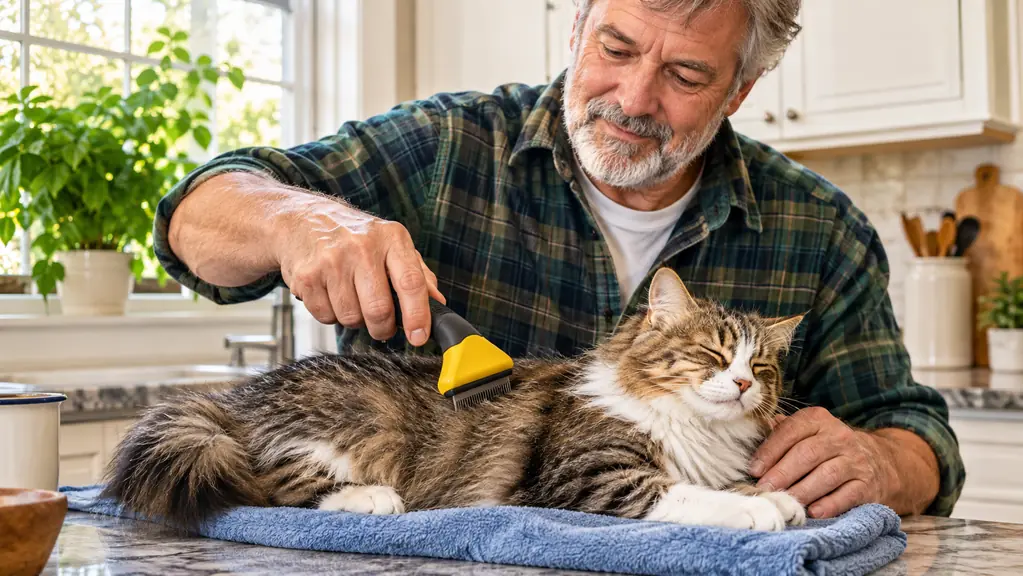
The first time I tried this was on the kitchen tile, right after her breakfast, and it went badly. She twisted away, the tool skidded sideways, and she left the room with her tail straight up. I did not try again for two days. When I did, it was on the back of the sofa at about two in the afternoon, mid nap, and that was a completely different cat. Same tool, same hand, different timing.
That is the ideal moment. Not when she is hungry. Not when she is waiting on the kitchen tile beside her dish. Not when the mail carrier is coming up the walk. If you want to know when your cat is ready, watch for the hour when she has stopped moving but has not yet gone stiff, because a deeply asleep cat does not want to be bothered any more than a hungry one does.
Go with the coat, not against it. Short strokes, two or three inches at a time, starting at the shoulders and working back toward the hips. Let the tool do the work and keep your wrist loose. If you lean on it, the curved edge will scrape, and a scrape is what teaches a cat to leave the room the minute she sees the brush come out.
Back and flanks first. Leave the belly, the legs, and the face alone. There is no undercoat worth having down there, and those are the areas where a cat will tell you exactly what she thinks of your plan.
Step 3: Five Minutes, Twice a Week, Then Stop
My first instinct was to keep going until the tool stopped filling up. That was a mistake. Somewhere around the ten minute mark Pepper got up and walked to the other end of the sofa, and the next day her skin looked pink along one shoulder. I called our vet's office to ask whether I had done damage. The woman who answered asked me three questions about how long I had gone and whether the skin was broken. It was not. She told me to leave that shoulder alone for four days and to keep sessions short from then on. That was the whole fix.
Five minutes, twice a week, is what we settled on. In spring, when she is blowing her coat, I add a third session. If she walks away, that is the end of it, even if it has only been two minutes. She comes back the next day. Nothing good comes from holding a cat down to finish a job.
Watch for redness, flaking, or a change in how she acts when the tool comes out of the drawer. If she starts hiding from it, back off for a week and then start again at two minutes. Cats keep grudges longer than people do.
Two five-minute sessions a week took Pepper from a hairball every other day to roughly one a month. Nothing else I tried did that.
Step 4: Empty the Tool Every Few Passes
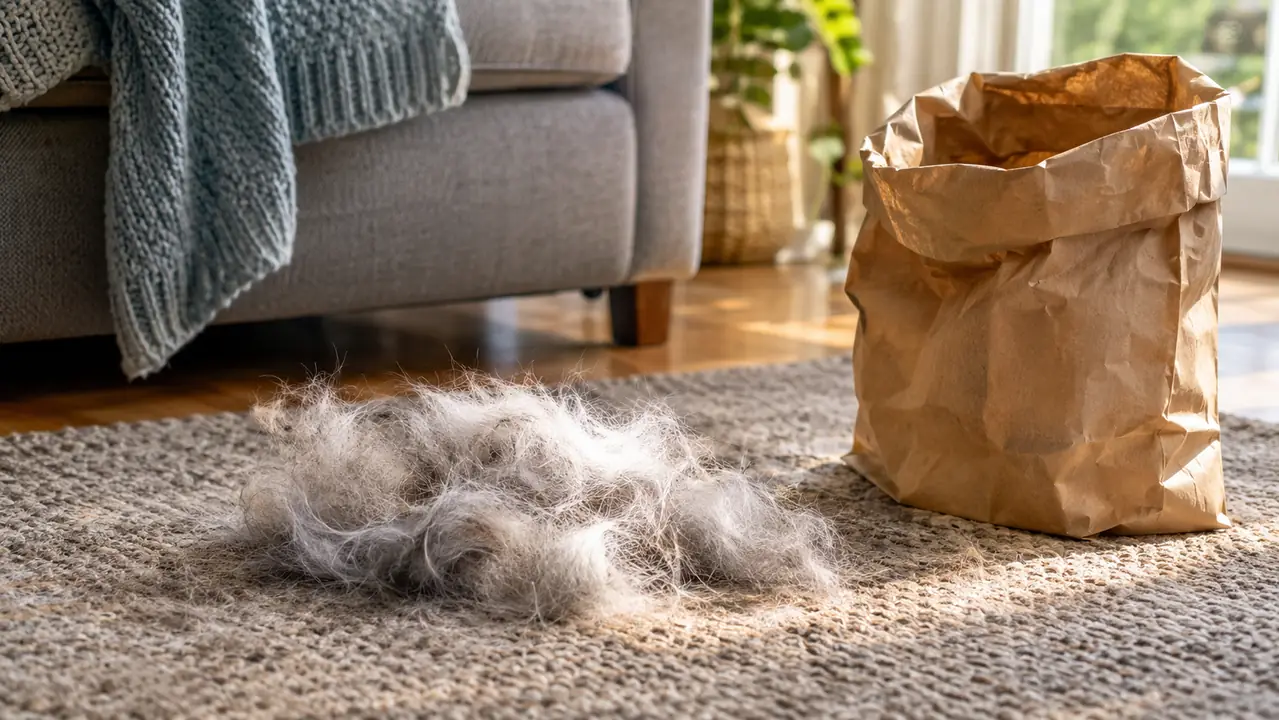
On a twelve-year-old cat in spring, this thing fills up fast. I keep a small trash bag beside me on the sofa and pull the fur out every four or five strokes. If you let it pack solid, the edge stops catching and you end up brushing the same surface hair over and over while the undercoat stays right where it was.
Wipe the edge with a dry cloth when you are done and put it somewhere it will not get knocked into a drawer full of things that will dull it. Five minutes a session adds up more than you would expect. Last April I collected enough in a week to fill a lunch bag, and it went out with the trash, which is the entire point of the exercise.
Step 5: Work on the Water Side Too
Brushing removed the source, but hairballs are also a plumbing problem, and plumbing runs on water. Pepper is a picky drinker. She ignores a bowl that has sat out since morning and she will not touch water with a bit of fur floating in it, which in a house with a cat is most water. I started changing her bowl in the kitchen twice a day and wiping it out between changes, and she drinks more than she used to.
For one week I measured what I poured and what was left, which is not scientific and proves nothing, but it was eye opening. She was drinking less than I would have guessed, and most of what she did drink happened overnight, which is why the bowl looked untouched all afternoon and I had stopped bothering to change it.
Our vet's advice at Pepper's last checkup was the same three things she always says to me. Watch her weight, watch her teeth, and watch how much she drinks, because all three get harder as a cat gets older. If your cat is barely drinking, that is worth a phone call, not a shopping trip. Hairballs and dehydration are not the same problem, and only one of them is fixed with a brush.
What Else Helps
Wet food. I am not going to pretend I switched Pepper to an all wet diet, because I did not. She gets a small portion of wet food in the morning and dry food the rest of the day, and I checked the amounts with our vet so I was not quietly undoing the weight conversation. Wet food puts water in the cat instead of beside her.
Fiber, but ask first. There is a lot of advice online about adding canned pumpkin or a fiber supplement to a cat's dish. Some of it is fine and some of it is wrong for a cat with a sensitive stomach, and Pepper has a sensitive stomach. I asked. Our vet gave me an amount and a limit, and I stuck to both. Do not guess at doses on a twelve-year-old cat.
The rest is unglamorous. Vacuum the carpeted stairs more often than you think you need to. Shake out the blankets Pepper sleeps on. Keep a lint roller by the front door and another one in the car. Then give the whole routine about a month before you decide it is not working. Ours slowed down inside two weeks, but a full coat cycle takes longer than that, and one good week is not proof of anything.
If you take one thing away from this, take the timing. Five minutes on a sleepy cat twice a week beats an hour of wrestling with a cat who has decided the brush is a predator. The FURminator does the heavy lifting on the undercoat. The rest is water, fiber only if your vet says so, and a vacuum that earns its keep.
Pepper's brush, the one piece of this routine that stuck
Short hair, cats over ten pounds, five minutes twice a week. If you are picking hairballs off the rug every few days, start here and give it a month.
Amazon Check Today's Price on Amazon →